
What Makes an Authentic Geisha District Walking Tour? A Kyoto Local’s Perspective.
Having welcomed over 20,000 international guests, there’s something we have always aimed to achieve at Wo.oW Travel: a walking tour that is about sharing, learning and understanding.
But what does an authentic geisha district walking tour actually mean to you?
Is Seeing a Geisha What Makes a Tour Authentic?
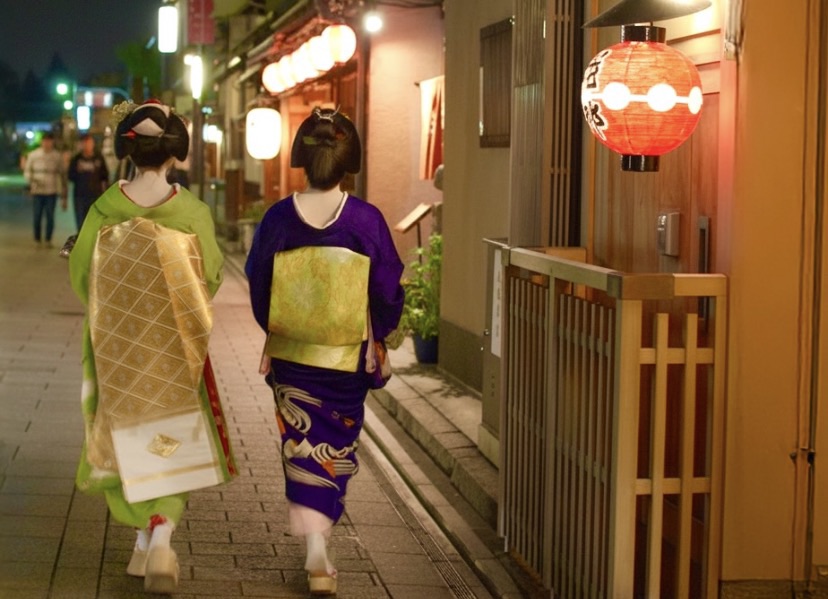
When you join a walking tour of Kyoto’s geisha district, almost every tour operator will take you to Hanamikoji Street, one of Gion’s most famous locations.
However, the possibility of encountering a geiko or maiko is just that — a possibility.
You may happen to see them on their way to or from work, but sightings are never guaranteed.
Many people believe that early evening is the best time to spot geiko and maiko, as they make their way to their evening engagements.
While this is certainly a possibility, we have also encountered them during our night tours, which begin at 8:45 pm.
The reality is that there is no particular time of day when you can be guaranteed to see them.
If seeing a geiko or maiko in person is an important part of your visit, I would recommend choosing an experience that includes a traditional performance alongside a walking tour.
Many of these experiences feature performances by maiko.
For those unfamiliar with the terminology, a maiko is an apprentice undergoing training to become a geiko, the Kyoto term for a geisha.
What Does an Authentic Geisha District Walking Tour Mean to Me, as Someone Born and Raised in Kyoto?
The world of geiko and maiko is not quite as closed to outsiders as it once was.
Today, international visitors have more opportunities to experience traditional maiko performances and even attend specially arranged ozashiki experiences, which were historically much less accessible to the general public.
I believe that watching a performance or taking part in one of these cultural experiences can be incredibly worthwhile.
There is something special about experiencing a traditional art form in person.
However, I also believe that there is another way to experience the authenticity of Gion.
What if your main interest isn’t simply seeing a geiko or maiko, but understanding the world they belong to?
What if you want to learn about the history, traditions and cultural significance of the geisha districts, and the people who have preserved these traditions over generations?
For travellers who are genuinely curious about these things, our geisha district walking tour offers something beyond visiting famous sightseeing spots.
Our aim is to introduce you to the culture itself — the history behind the streets, the traditions of Gion, and the stories that help explain why this area remains such a special part of Kyoto.
And I believe that this, too, is an authentic experience.
When you understand more about the history and cultural background of geiko and maiko, I think the way you see them may change.
Rather than simply seeing someone dressed in a beautiful kimono, you may begin to appreciate the years of training, dedication and tradition behind their appearance.
Authenticity Means Different Things to Different People
Ultimately, I believe that what makes a tour authentic depends on your own interests and values.
For some visitors, authenticity may mean witnessing a traditional performance in person.
For others, it may mean walking through historic neighbourhoods, listening to local stories and gaining a deeper understanding of a culture that is often misunderstood.
Neither experience is necessarily more authentic than the other. They simply offer different ways of discovering Kyoto.
At Wo.oW Travel, we believe that a meaningful walking tour should be about more than simply seeing the sights.
Our guides share their knowledge, experiences and perspectives to help visitors understand the culture and history of Gion, including local stories and insights that aren’t always easy to discover online.
If you’d like to explore not only the streets of Gion, but also the stories and traditions behind them, we would love to share this part of Kyoto with you.

Comments are closed